
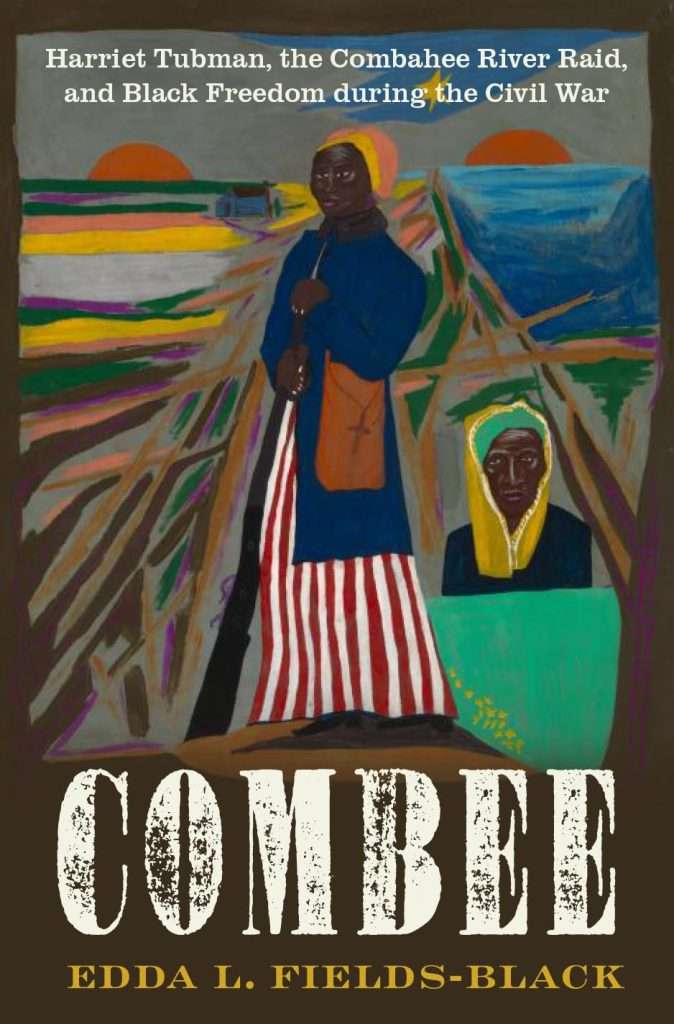
 In the spring and summer of 1863, as the outcome of the Civil War, and with it the fate of the nation, hung in the balance, United States forces struggled to capture the offensive.
Along the coastal waters of South Carolina, the US Navy had taken the port cities of Port Royal and Beaufort, where war ships blasted their way into the harbor, resulting in the fleeing of wealthy white planters and other residents inland in the “Great Beaufort Skedaddle.”
With a foothold on the coast, the Union then made plans to attack the expansive rice plantations lining the maze of rivers that fed into and out of the South’s heartland, including the Combahee River.
On the night of June 1, 1863, three federal gunboats steamed upriver from Beaufort and, starting early the next day, destroyed seven plantations along the Combahee, resulting in the liberation of more than 700 enslaved people.
One of the most successful of the war, the raid was also, argues Edda Fields-Black in COMBEE: Harriet Tubman, the Combahee River Raid, and Black Freedom during the Civil War (Oxford University Press, 2024), the largest slave rebellion in the continental United States.
Those enslaved along the Combahee knew “Lincoln’s gun-boats” were coming and seized their freedom when they saw the chance. The raid was remarkable in several other ways: it was carried out by one of the earliest all-Black regiments, the U.S. 2nd Second South Carolina Volunteers, and its gunboats were guided by Harriet Tubman.
Fields-Black’s book offers the fullest account to date of this pivotal and dramatic event and the critical role that Tubman played in it.
Drawing on original research she recreates the world of the rice plantations and especially those in the “prison-house of bondage” who made them so profitable.
She uses the archives to give these enslaved laborers names and stories, inscribing them permanently into the historical record. Among them is her third-great grandfather.
Destructive as it was, a humbling blow to the Confederacy’s morale, the raid was also an act of creation, contributing to the formation of the community that thrives to this day in the Gullah Geechee Corridor.
Upcoming Author Event
The Cayuga Museum will host Dr. Edda Fields-Black, who won the 2025 Pulitzer Prize for her in-depth look into Harriet Tubman’s service role during the Civil War as part of the museum’s 2026 Richard N. Hill History Conversation.
Attendees will get a fresh look at the life of Auburn’s best known resident, and get a chance to explore Dr. Fields-Black’s journey in uncovering this lesser known aspect of Tubman’s extraordinary life.
The event will take place on Friday, November 6, at 7 pm at the Carriage House Theater, 203 Genesee Street, in Auburn, NY. Admission is $35 for the general public and $30 for museum members.
A VIP reception will take place prior to the History Conversation from 5 until 6 pm. Tickets for the reception are $100. VIP tickets include access to the reception and an opportunity to meet the author, as well as a free copy of COMBEE, a complimentary beverage, and admission to the History Conversation. Tickets can be purchased at the door or in advance at cayugamuseum.org/history-conversation
Dr. Edda L. Fields-Black is an award-winning historian, artist, and public humanities scholar who specializes in technology and labor in West Africa and the US South. Her passion is uncovering voices that are not recorded in written sources and have not been previously heard and telling stories that heretofore have not been told.
Fields-Black also translates her historical research into artistic platforms. She took “history off the shelf and put it on stage,” writing libretto for Unburied, Unmourned, Unmarked: Requiem for Rice (with three-time Emmy Award-winning classical music composer, John Wineglass), the first full symphonic work about slavery, and serving as executive producer for the project.
Fields-Black also has worked as a consultant for permanent exhibits, “Rice Fields of South Carolina” at the Smithsonian National Museum of African American History and Culture and “Carolina Gold” at the International African American Museum, and “From Slavery to Freedom” at the Senator John Heinz History Center.
Book Purchases made through Bookshop.org support both your local independent bookstore and New York Almanack’s mission to report new publications relevant to New York State. Purchases via this Amazon link also support the Almanack.

Leave a Reply