 The Hudson River begins as a small mountain lake on the side of the state’s highest peak Mt. Marcy and ends in New York Harbor, one of the world’s busiest and most populated metropolitan ports. About halfway along its course it becomes an estuary, an arm of the sea, that provides spawning and nursery grounds for commercially valuable fish, crabs, and shellfish. [Read more…] about Hudson River Estuary Wildlife and Habitat
shellfish
Long Island Baymen & Great South Bay Seafood
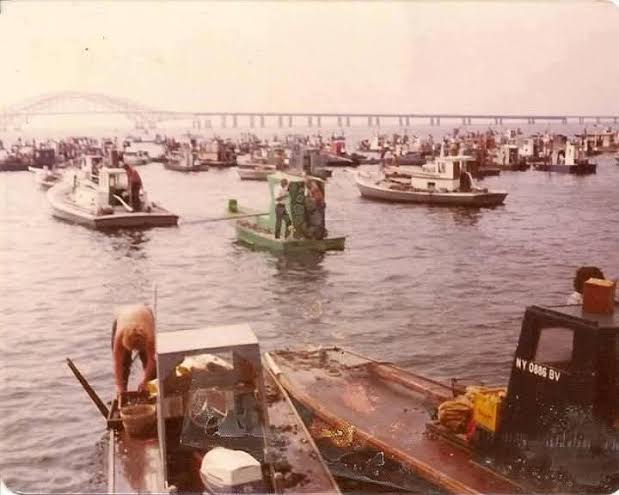 The waters around Long Island were long known for their bounty. Fish and oysters sustained the indigenous population long before the coming of Europeans.
The settlers developed full-fledged oyster (Crassostrea virginica) and then hard clam (Mercenaria mercenaria) industries and fished striped bass, bluefish, flounder (fluke), and weakfish. [Read more…] about Long Island Baymen & Great South Bay Seafood
Women’s Role in Canned Food Consumption
 New York State was the birthplace of the American canning industry and grew to become one of the nation’s most prolific food processing hubs by the late 19th century. The state’s history is marked by early technological developments, massive growth during wartime, and the rise of major corporate processors.
Initially, canned foods were not widely accepted, however. The overarching factor that drove the prevalence and public acceptance of canned food was the symbiotic relationship between the evolving canning industry and the changing role of women, in particular their need or desire to work in the public sphere. [Read more…] about Women’s Role in Canned Food Consumption
Gowanus Canal is Getting Cleaner Every Day
 The Gowanus Canal (originally known as Gowanus Creek) is a 1.8-mile-long waterway in Brooklyn that was once a saltwater marsh teeming with wildlife, but is now among the most polluted bodies of water in the United States.
The area’s early settlers, on the first land patents issued in Breukelen (today Brooklyn), named the waterway “Gowanes Creek” after Gouwane a sachem (chief) of the Canarsee, an indigenous Lenape tribe who exploited the waterway’s resources and farmed its shores. [Read more…] about Gowanus Canal is Getting Cleaner Every Day
Catalonia in Manhattan: The Architectural Legacy of Rafael Guastavino
 At the start of the 1880s, Barcelona was an expanding city of about 350,000 people. Its medieval walls had been knocked down only twenty-five years earlier. Capital of the autonomous community of Catalonia, city and region developed into Spain’s economic dynamo. Prosperity mushroomed. A self-confident territory strove to re-establish its identity by invigorating local traditions, culture and language. Barcelona became an engine of change and modernity. [Read more…] about Catalonia in Manhattan: The Architectural Legacy of Rafael Guastavino
Dead Horse Bay: Polluted and Disgusting, but People Can’t Stay Away
 A quick glance at Instagram shows some odd hauls from Dead Horse Bay. They’re not windowpane flounder or diamondback terrapins or cockle clams local to the waters. They’re rainbows of vintage marbles, shards of heirloom ceramics, and even rusted bicycles from the era of black and white television.
Scour Reddit from the past year alone and find posts about Dead Horse Bay mudlarking — that is, scavenging the shore for interesting, possibly valuable items. [Read more…] about Dead Horse Bay: Polluted and Disgusting, but People Can’t Stay Away
The Development of Staten Island
 Relative to the New York-New Jersey metropolitan area, Staten Island has been both water-bound and isolated. Historically, the island’s western border, the Arthur Kill channel, and its northwestern border, the Kill Van Kull, played vital roles connecting New York with New Jersey, Philadelphia, and Long Island Sound.
Staten Island rests between New York Bay and New Jersey’s northwestern shoreline, the Arthur Kill channel separating the Island from the latter. The Island’s geographical center is situated 11 miles southwest of New York City. [Read more…] about The Development of Staten Island
Aggressive Invasive Golden Clam Found in Lake Champlain
 In late October Lake Champlain Committee (LCC) community science volunteer Ashley Leemans tossed an aquatic rake into Lake Champlain and pulled in a clam while doing a routine monitoring check for aquatic invasive species (AIS) at the South Bay Boat Launch in Whitehall, New York. Leemans immediately reported her finding complete with photos to LCC who followed-up with state agencies that conducted further analysis and confirmed that the mollusk was the golden clam (Corbicula fluminea). [Read more…] about Aggressive Invasive Golden Clam Found in Lake Champlain
How Flooding Impacts Aquatic Life
 July 2023 was the hottest month ever recorded worldwide, according to the National Oceanic and Atmospheric Administration. Rising temperatures associated with climate change have dramatically increased atmospheric moisture, causing more frequent and severe storms. [Read more…] about How Flooding Impacts Aquatic Life
Africans in Dutch New Netherland: A Sensory & Culinary History
 In early New Netherland and New Amsterdam new arrivals, Black and white, tried to recreate the world they had left. As historical sources are scarce and incomplete, historical interpreter and culinary historian Lavada Nahon uses deep empathy and imagination to depict the sensory world of the enslaved.
It is easy to put the Africans on the same playing field as the Europeans in their sensory experience of New Netherland. To imagine that they, like the Dutch, could immediately begin recreating, reconstructing their home world in the New World, bringing forth those deep sensual parts of human experience that they had left behind in Africa. But believing that they could do so in a timely manner means negating their everyday reality. [Read more…] about Africans in Dutch New Netherland: A Sensory & Culinary History
Coordination of Many Legged Locomotion
 Grinning and giggling, my one-year-old son ran across the living room, only to trip over his own feet and faceplant on the carpet. Sometimes, two legs can be too many to coordinate. How, then, do invertebrates walk with six, eight, or hundreds of legs?
In some ways, walking for insects, arachnids, and myriapods (a group that includes millipedes and centipedes) isn’t that different than it is for us. [Read more…] about Coordination of Many Legged Locomotion
$1.4M For Hudson River Estuary Community Projects
 New York State Department of Environmental Conservation (DEC) has announced grants totaling more than $1.4 million for 23 projects to help communities along the Hudson River Estuary improve water quality and enhance environmental education and stewardship.
The announcement coincides with the 20th Annual ‘Day in the Life of the Hudson and Harbor,’ where 5,000 student scientists are gathering along the Hudson River and New York Harbor to collect data on the Hudson’s fish and invertebrates, track the river’s tides and currents, and examine water chemistry and quality. [Read more…] about $1.4M For Hudson River Estuary Community Projects
Poachers Using Nets Face Charges in Suffolk, Sullivan Counties
 According to a press release issued by DEC, on August 17th, NYS Environmental Conservation Officers Dickson and Pabes responded to the Captree Fishing Pier at Captree State Park in Suffolk County on Long Island after receiving reports of anglers using nets to catch undersized crabs and other species. [Read more…] about Poachers Using Nets Face Charges in Suffolk, Sullivan Counties
Jonathan Swift’s Oyster Test: Oysters, Sex and Culture
 At least since Roman times oysters were associated with sex. The most obvious reason for this association is the oyster’s resemblance to the pudendum. Raw oyster was praised as an aphrodisiac. Giacomo Casanova boasted to have eaten fifty at breakfast together with a lady of his fancy.
European painters used oyster as a symbol of fertility and sexual pleasure. Aphrodite (Venus), the Goddess of love and lust, was blown over sea on an oyster shell landing at either Cythera of Cyprus (both islands were regarded by the Greeks as territories of Venus). In “The Birth of Venus” Botticelli painted her approaching the shore on a giant oyster (clam) shell. By then, the associations with female beauty and physical love were well established. [Read more…] about Jonathan Swift’s Oyster Test: Oysters, Sex and Culture
Oyster Slurpers: A Tale of Two Rivers
 For thousands of years the Thames provided London’s inhabitants with a plentiful supply and variety of fish. Until the 1820s locally caught fish was the city’s staple diet. Subsequent pollution of the river drove many professional fishermen and their families into financial ruin because of the collapse of fish populations.
Up until the twentieth century New York Harbor oysters reigned as the quintessential New York food long before pizza, pretzels, bagels, or hot dogs took their place. The metropolis once was a Big Oyster. There too, reckless management of the marine environment led to the obliteration of a huge natural resource. [Read more…] about Oyster Slurpers: A Tale of Two Rivers
The Oysters Sign: 19th Century Boxing’s Most Prized Trophy
 When bare-knuckle “fair fight” pugilism reached a height in popularity in England in the early 1820s, many English boxers moved to the city of New York. Some simply for greener, less crowded professional pastures and others out of frustration over corruption or suppression of the sport by British authorities.
In the United States, these men bolstered the “manly art of self defense” by competing in local matches, opening gymnasiums, arranging fights, and training a new generation of American boxers. [Read more…] about The Oysters Sign: 19th Century Boxing’s Most Prized Trophy
1940s Tugboat, Barge Sunk For Artificial Reef
 New York State Department of Environmental Conservation (DEC) has announced the deployment of two steel vessels, the Chickadee on the McAllister Grounds Reef and Barge 226 on Smithtown Reef, as part of the State’s ongoing efforts to expand New York’s network of artificial reefs.
These final deployments for 2021 continue to build on DEC’s efforts to develop a stronger, more diverse marine ecosystem and provide shelter for fish and other marine life off New York’s shores. [Read more…] about 1940s Tugboat, Barge Sunk For Artificial Reef
The Joy of Eating: Billy Possum, Fat Men Clubs & Obesity History
 Weightism is a bias or discrimination against people who are overweight. It is based on a set of stereotypes about the abilities of overweight individuals and includes prejudices that they are self-indulgent, socially inept, and mentally slow. Obesity was judged to be incompatible with intelligence and acuity.
The weight stigma is a relatively modern one. Fat shaming started in the 1950s. In March 1954, Life magazine featured an article entitled “The Plague of Overweight” in which obesity was described as the most serious health problem of the day. Without any further consideration the condition was linked to gluttony. At the time, only around three percent of Americans were considered overweight.
From the Renaissance onward, obesity had suggested wealth and power. It pointed at the means to supply and enjoy the luxury of food. Plumpness equaled prosperity. If one’s body was a temple, then being the size of a cathedral signaled status. Physical proportion was a badge of economic and physical well-being, both in individual and national terms. [Read more…] about The Joy of Eating: Billy Possum, Fat Men Clubs & Obesity History
Deep Time: Lake Ontario’s Lucky Stones & Fossils
 When did homo sapiens arise? Maybe 2 million years ago?
Nobody really knows exactly when we became “human,” but most of the rocks on our Lake Ontario beaches are at least a hundred times older than our species.
This is what the geologists mean by “deep time.” [Read more…] about Deep Time: Lake Ontario’s Lucky Stones & Fossils
Storm Closes Shellfish Harvest at Long Island
 NYS Department of Environmental Conservation (DEC) has announced emergency temporary shellfish closures are in effect for areas of Nassau and Suffolk counties due to the extremely heavy rainfall and extraordinary amounts of stormwater runoff and localized street flooding on October 26th and October 27th.
DEC temporarily closes specific areas that exceed certain rainfall amounts to prevent the harvest of potentially contaminated shellfish and to protect public health. [Read more…] about Storm Closes Shellfish Harvest at Long Island