 Under orders from the Republican administration of Donald Trump and Defense Secretary Pete Hegseth the US Army has presented final design plans to the US Commission of Fine Arts to restore and reinstall the Confederate Memorial (now being formally referred to as “the Moses Ezekiel Sculpture”) at Arlington National Cemetery. [Read more…] about Confederate Memorial Being Reinstalled at Arlington National Cemetery
Reconstruction
Upstate NY Incidents in the Life of Louisa Jacobs
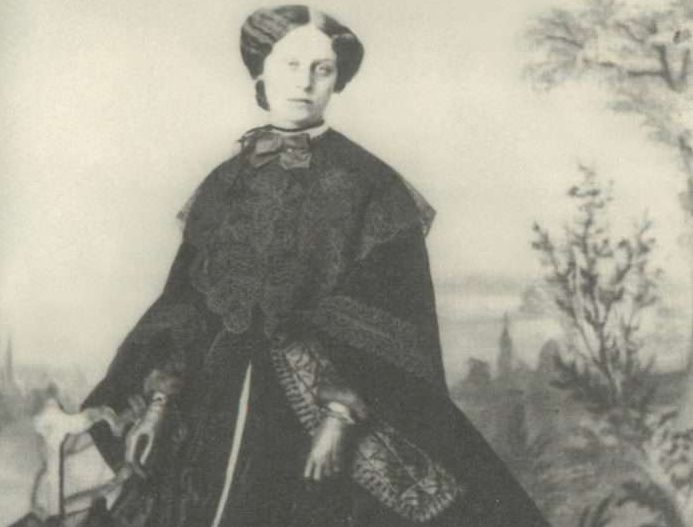 Louisa Matilda Jacobs (1833-1917), daughter of Incidents in the Life of a Slave Girl author Harriet Jacobs (1813-1897), was born enslaved by Dr. James Norcom in Edenton, North Carolina, but spent considerable time in Upstate New York. [Read more…] about Upstate NY Incidents in the Life of Louisa Jacobs
The Voting Rights Act & The Great Betrayal of 1877
 On April 24, 1877, on orders from President Rutherford B. Hayes, federal troops withdrew from the state house in Louisiana — the last federally defended state house in the South — just 12 years after the end of the Civil War.
This withdrawal marked the end of Reconstruction and paved the way for the unrestrained resurgence of white supremacist rule in the South, carrying with it the rapid deterioration of political rights for Black Americans.
What began with Hayes’s elevation to the Presidency following the disputed Election of 1876, is now having dramatic political consequences 150 years later. [Read more…] about The Voting Rights Act & The Great Betrayal of 1877
Manhattan’s Statue to Unrepentant Racist Samuel Sullivan Cox
 There is a statue of Samuel Sullivan Cox in Manhattan’s Tompkins Square Park. The statue originally was near Cox’s home on East 12th Street but in 1924 it was moved.
A plaque accompanying the statue reads “Samuel Sullivan Cox, the Letter Carrier’s Friend, Erected in Grateful and Loving Memory of his Services in Congress by the Letter Carriers of New York, his Home, and of the United States, his Country.” [Read more…] about Manhattan’s Statue to Unrepentant Racist Samuel Sullivan Cox
George Boutwell: Radical Republican and Champion of Democracy
 During his seven-decade career in public life, George Sewall Boutwell sought to “redeem America’s promise” of racial equality, economic equity, and the principled use of American power abroad.
From 1840 to 1905, Boutwell was at the center of efforts to abolish slavery, establish the Republican Party, assist President Lincoln in funding the Union war effort, facilitate Lincoln’s Emancipation Proclamation, impeach President Andrew Johnson, and frame and enact the Fourteenth and Fifteenth civil rights amendments. [Read more…] about George Boutwell: Radical Republican and Champion of Democracy
Jan 20, 1870: America’s 1st Black Member of Congress Denied His Seat
 On January 20, 1870, Hiram Rhodes Revels (1827-1901) was elected to the U.S. Senate, and slated to become the first African American to serve in the U.S. Congress. Revels was elected in Mississippi to fill the vacancy left after the state’s secession from the United States prior to the Civil War. [Read more…] about Jan 20, 1870: America’s 1st Black Member of Congress Denied His Seat
Oct 1883: An Albany County Justice Helps Strike Down Civil Rights
 Radical Republican Senator Charles Sumner of Massachusetts introduced the Civil Rights Act in 1870 as an amendment to a general amnesty bill for former Confederates who had fought against the United States during the Civil War. His bill guaranteed all citizens, regardless of color, access to accommodations, theatres, public schools, churches, and cemeteries. It also forbid the barring of any person from jury service on account of race, and provided that all lawsuits brought under the new law would be tried in federal, not traditionally racist state courts.
Sumner predicted that the Civil Rights Act would be the greatest achievement of Reconstruction, saying “Very few measures of equal importance have ever been presented.” [Read more…] about Oct 1883: An Albany County Justice Helps Strike Down Civil Rights
Interracial Marriage: Some History of Anti-Miscegenation Laws
 The interracial marriage prohibition is deeply rooted in our Nation’s history and tradition. Statutes prohibiting interracial marriage were enforced in American colonies and states for more than three centuries.
The first anti-miscegenation law was enacted in Maryland in 1661. Virginia followed suit soon after. [Only Connecticut, New Hampshire, New York, New Jersey, Vermont, Wisconsin, Minnesota, Alaska, Hawaii, and Washington, D.C. never enacted anti-miscegenation laws.] [Read more…] about Interracial Marriage: Some History of Anti-Miscegenation Laws
Heather Cox Richardson’s Democracy Awakening: Notes on the State of America
 At a time when the very foundations of democracy seem under threat, the lessons of the past offer a roadmap for navigating a moment of political crisis. In Democracy Awakening: Notes on the State of America (Viking, 2023), historian Heather Cox Richardson delves into the tumultuous journey of American democracy, revealing how the roots of Donald Trump’s “authoritarian experiment” can be traced back through the earliest days of the republic. [Read more…] about Heather Cox Richardson’s Democracy Awakening: Notes on the State of America
Professional Racist John Van Evrie & The New York Weekly Day Book
 Southern secession was a disaster for American nationalists with a pro-slavery vision. Few were as virulent as John Van Evrie (1814–1896), a Canadian educated as a physician, who spent the 1850s building a publishing company that churned out pro-slavery works, including the notorious New York Weekly Day Book newspaper.
Van Evrie’s pseudoscience theories, which lacked evidence even for the time, claimed black people were inferior to white people, defended slavery as practiced in the United States, and attacked abolitionism. [Read more…] about Professional Racist John Van Evrie & The New York Weekly Day Book
Albany’s Daniel Manning: Newspaperman & Secretary of the Treasury
 Daniel Manning was born in Albany, NY, on August 16, 1831, the second son of John and Eleanor Manning. The Mannings were of Irish, English, and Dutch descent.
Daniel was six at the time of the Panic of 1837 when his father died, causing financial strain on the politically connected family. When Daniel was ten he was appointed a page in the New York State Assembly where he served for two years. During the second year, he also got a job distributing the Albany Atlas newspaper. [Read more…] about Albany’s Daniel Manning: Newspaperman & Secretary of the Treasury
New Historical Marker For Willis Hodges & His Adirondack Black Farm Settlement
 On Sunday, August 6, a new historical marker will be unveiled at Loon Lake, Franklin County in the Adirondacks, to honor the settlement of Blacksville and its founder, Virginia-born Brooklyn newsman and Black rights activist, Willis Hodges. The public is invited to attend. [Read more…] about New Historical Marker For Willis Hodges & His Adirondack Black Farm Settlement
Arlington National Cemetery Removing Confederate Memorial
 Arlington National Cemetery (Arlington) is removing its Confederate Memorial, as mandated by the Congress’s authorizing the Naming Commission to rename and/or remove Department of Defense assets that commemorate the Confederate States of America (CSA) or any person who voluntarily served with the CSA against the United States. [Read more…] about Arlington National Cemetery Removing Confederate Memorial
Kermit Roosevelt III: The Nation That Never Was
 In his book The Nation That Never Was: Reconstructing America’s Story (University of Chicago Press, 2022), Kermit Roosevelt III argues that a traditional American narrative – “that our fundamental values as a country were stated in the Declaration of Independence, fought for in the Revolution, and made law in the Constitution”– is neither useful nor true.
Instead, he writes, we should look to the 19th century, to the period following Abraham Lincoln‘s Gettysburg Address, “when it was possible to envision the emergence of the nation committed to liberty and equality.” [Read more…] about Kermit Roosevelt III: The Nation That Never Was
Benjamin Franklin Butler: A Noisy, Fearless Life
 Benjamin Franklin Butler was one of the most important and controversial military and political leaders of the Civil War and Reconstruction eras.
In her new biography, Benjamin Franklin Butler: A Noisy, Fearless Life (Univ. of North Carolina Press, 2022), Elizabeth D. Leonard chronicles Butler’s successful career in the law defending the rights of the Lowell Mill girls and other workers, his achievements as one of Abraham Lincoln’s premier civilian generals, and his role in developing wartime policy in support of fugitives from enslavement as the nation advanced toward emancipation. [Read more…] about Benjamin Franklin Butler: A Noisy, Fearless Life
The 1883 Civil Rights Cases, the 14th Amendment, and Jim Crow New York
 The United States Supreme Court is now poised to overturn Roe v. Wade. In a draft opinion, Justice Samuel Alito described the 1973 7-2 Court decision as an over-extended application of the federal government’s 14th Amendment responsibility to protect the right of citizens to due process and equal protection of the law. He argued “Roe was egregiously wrong from the start.”
The Supreme Court took a similar position on the 14th Amendment in the 1883 Civil Rights Cases when an earlier conservative majority declared the Civil Rights Act of 1875 unconstitutional, effectively ending the post-Civil War Reconstruction era and ushering in 100 years of state and local Jim Crow segregation laws.
In the Civil Rights Cases, the Supreme Court consolidated four challenged to the constitutionality of the Civil Rights Act. One of the cases, U.S. v. Singleton, involved the refusal by a New York theater to admit an African American patron who had purchased a ticket. [Read more…] about The 1883 Civil Rights Cases, the 14th Amendment, and Jim Crow New York
Harvard Library Focuses On Improving Access To Black History Collections
 Houghton Library, Harvard University’s largest rare books and manuscripts repository, is home to hundreds of thousands of materials relating to history across the world. Houghton’s collections related to Black history range from the 18th century through today, but have been difficult to find among all the other material.
During the 2020‒21 academic year however, library staff paused their other digital projects to focus on building the collection related to Black American history. The effort has made more primary sources by and about African Americans available digitally, along with a considerable amount of context. [Read more…] about Harvard Library Focuses On Improving Access To Black History Collections
List of America’s Public Monuments Reveals One-Sided History Obsessions
 Who are the 50 individuals most frequently represented by a public monument in the US? What percentage of those 50 are white and male? How many are women? And what are the dynamics that helped shape who is — and who is not — on that list?
Answers to those questions are among the findings of the National Monument Audit, a first-of-its-kind report issued by Monument Lab, a Philadelphia-based nonprofit art and history studio. [Read more…] about List of America’s Public Monuments Reveals One-Sided History Obsessions
Racism’s War On Equality Has A Long History
 As part of the New York Times’ 1619 Project, examining the history of race and racism since slavery was introduced into British North America four hundred years ago, D’Angelo Lovell Williams argues that race and racism have long torpedoed efforts to implement universal health care in the United States.
According to Williams, federal policy, starting with the end of the Civil War in 1865, was based on the belief that “free assistance of any kind” to newly freed Blacks would “breed dependence and that when it came to black infirmity, hard labor was a better salve than white medicine.”
Those are beliefs echoed in politics and rhetoric today, but one of the worst racists in the United States Congress at that time, whose views shaped post-Civil War policy, was Samuel Sullivan Cox. During the 38th session of Congress, Cox led opposition against the formation of a Freedmen’ Bureau to assist newly emancipated Africans based on his belief that that African race was doomed to extinction by its inherent inferiority and inability to survive outside of bondage. [Read more…] about Racism’s War On Equality Has A Long History