
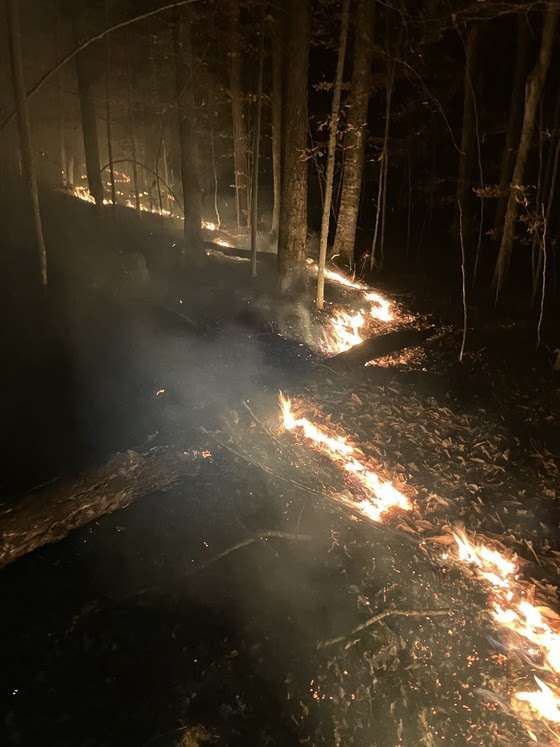
 Several wildfires have recently broke out as dry conditions and fallen leaves exacerbate the fire danger. Be extremely careful with all types of outdoor fires to avoid dangerous risks due to dry weather.
The Fire Danger has been elevated to HIGH in the Catskills and most of Eastern Upstate New York and may rise higher and/or spread to other parts of the state in the coming days.
Much of the state is Abnormally Dry according to the US Drought Monitor.
Recent Fires
Over the past 11 days several wildfires have burned some 275 acres in New York State.
On October 20, in the Village of Sharon Springs in Schoharie County, a 1.2-acre fire was discovered burning full length trees cut down by a landowner. The landowner hired a bulldozer operator to construct a fire line around the perimeter.
 The fire was reported around 3 pm and by about 4:30 pm, the bulldozer had completed 100% containment. NYS Forest Rangers continued to check hotspots each day until October 23, when the fire was finally declared to be out.
On October 21, a wildfire was reported in the Piercefield Flow near the Village of Tupper Lake in Franklin County. Rangers and the Tupper Lake Fire Department contained the 375-square-foot fire. The cause of the fire was an illegal campfire.
On October 22, at around 6:30 pm, a wildfire was reported on Chicken Farm Road in the Town of Butternuts in Otsego County. The nearly two-acre fire was mostly burning leaves and was contained by Forest Rangers around 8:45 pm.
On October 24, a wildfire was spotted around 8:30 pm from the Indian Lake Overlook on Route 30 in the Town of Indian Lake in Hamilton County. The fire likely began east of Center Pond in the Siamese Ponds Wilderness.
 Four Forest Rangers and Indian Lake Fire Department responded as the fire grew to about 21 acres. Firefighters worked into the night and brought the fire under control at about 2:30 pm. Read more about the fire here.
On October 25, a wildfire was reported as a small 1.5-acre brush fire near Mattison Hollow on the Taconic Crest Trail in Berlin, in Rensselaer County.
Steep and rocky conditions made fighting the blaze difficult and it quickly spread to some 251 acres, requiring more than a hundred firefighters from neighboring states, and the National Guard.
Fire crews reached full containment by the evening of October 27th. Read more about the fire here.
Fire Danger Remains Elevated
Daily fire danger ratings may fluctuate based on weather, but the overall situation is elevated beyond what is typical for this time of year. With the fall foliage season in full swing, fire risk will continue to be a concern.
 People often think a fire has been extinguished, but in dry conditions, hot embers burn into the ground where they can smolder for days or even weeks before being detected as a wildfire.
Due to high fire danger and extended dry conditions, campers, hunters, and all outdoor recreationists are discouraged from having campfires outside of established fire rings or pits that keep the fire contained.
If you feel strongly that you must have a campfire, keep them small and extinguish them completely. To properly extinguish a campfire, pour copious amounts of water on the fire, stir any remaining coals to mix the water into the fire bed, and make sure the fire is cool to the touch before leaving it.
If you encounter a wildfire in the forest, dial 911 to report the fire and be prepared to give a location of the fire to first responders. If you encounter unattended campfires on DEC lands, contact Forest Ranger Dispatch at 1-833-NYS-RANGERS (1-833-697-7264).
Wildfire Prevention Tips
Completely extinguish all campfires. Fires should be doused with water and stirred to mix ashes and water until ashes are cool enough to touch with the back of your hand. Remember, if it’s too hot to touch, it’s too hot to leave.
Never discard ashes from campfires, charcoal grills, woodstoves, or cigarettes on vegetation or the forest floor.
 Refrain from smoking in areas with flammable vegetation or organic soils. Cigarette butts and ashes should never be discarded in the forest regardless of location. If you carry it in, carry it out!
Do not drive off an established road or park on top of vegetation. Hot mufflers and catalytic converters can ignite vegetation that touches them.
When operating chainsaws, generators, and other power equipment, ensure it has a functioning muffler with spark arrestor.
Have supplies (shovel, water, fire extinguisher) to deal with a fire if one should start.
Check local regulations for your intended destination for any additional restrictions on fires.
Make sure that all vegetation and flammable material are far away from your fire.
Never leave a fire unattended. Always be careful with fire.
 Air Quality Impacts
Cool autumn nights can lead to light winds and limited atmospheric mixing, so local pollution sources, like chimneys, traffic, and industrial processes can build up, leading to higher levels of particulate matter.
This week, brushfires over the Southern United States have been bringing smoke into New York.
Most of it stays aloft and is not as intense as the wildfire smoke seen from western wildfires, but there’s still a portion of the fine particles that settle.
Available Resources
New York Almanack Wildfire Stories
Illustrations, from above, provided by DEC: the Indian Lake fire; the Tupper Lake illegal campfire-caused wildfire; the wildfire near Indian Lake; recent NYS Fire Danger and US Drought Monitor maps; and smoke and poor air quality at a Big Ben Preserve prescribed burn October 19, 2026.

Leave a Reply