
 The waters around Long Island were long known for their bounty. Fish and oysters sustained the indigenous population long before the coming of Europeans.
The settlers developed full-fledged oyster (Crassostrea virginica) and then hard clam (Mercenaria mercenaria) industries and fished striped bass, bluefish, flounder (fluke), and weakfish.
The local men who worked the bay, baymen, dredged and raked the shallow bottoms. They gathered some of the first oysters ever exported from the United States to Europe and by the 1880s where taking some 70,000 barrels a year.
The Oyster Industry
Wild oysters had always populated the Great South Bay, but commercial cultivation truly began after the War of 1812.
The bay provided an ideal environment. The lower-salinity waters of the East Bay protected vulnerable seed oysters (larvae) from natural ocean predators.
Once slightly matured, baymen transplanted them to saltier, nutrient-dense waters of the West Bay near the Fire Island Inlet, which gave the bivalves a distinctively crisp, savory taste.
The industry was so lucrative that entire coastal communities like West Sayville, Blue Point, and Patchogue were built around it.
Local legends like Jacob Ockers (1847–1918), known as the “Oyster King,” amassed massive wealth, and the industry provided livelihoods for thousands of local baymen and processing factory workers.
Ockers’ Blue Point Oyster Company shipped nationwide and served as luxury items in high-end restaurants across New York City, London, and Paris.
At its peak between 1880 and 1910, the United States produced roughly 160 million pounds of oyster meat per year — more than the rest of the world combined. However, the wild industry rapidly collapsed over the next several decades.
The introduction of increasingly mechanized dredging from the mid-nineteenth onward, scraped away entire ancient reefs. Taking the shells out of the water left no hard surfaces (cultch) for new oyster larvae to attach to and grow.
The initial crash hit between 1910 and 1930 as coastal pollution intensified. As coastal cities expanded, sewage and industrial runoff contaminated major oyster beds.
Public outbreaks of typhoid and gastrointestinal illnesses linked to raw shellfish caused consumer demand to plummet. The Great Hurricane of 1938 physically buried many Great South Bay beds under heavy sediment.
By the 1940s and 1950s, the Great South Bay oyster industry had almost entirely disappeared, eventually being supplanted by a shift to hard clamming.
Hard Clamming Decline
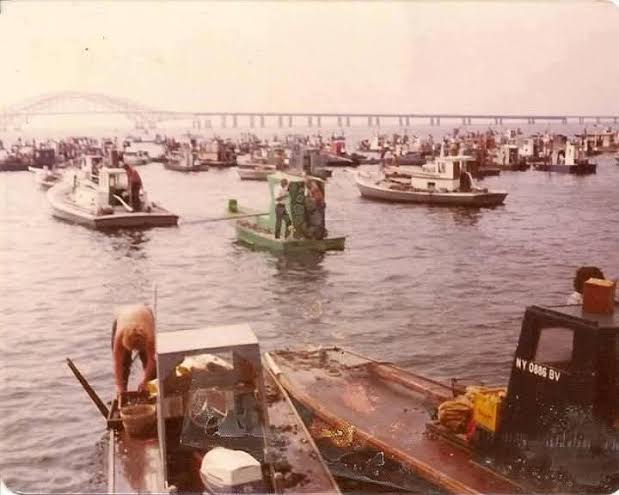
Hard clams remained abundant after oysters declined. As the clamming industry began to peak in the 1960s, hundreds of flat-bottomed clam boats gathered daily at Babylon, Lindenhurst, Bay Shore, and elsewhere.
At the same time suburban development led to increased pollution, especially from lawn fertilizers and septic systems. This triggered recurring “brown tide” algae blooms that choked out the clams’ food supply and stunted their growth.
Great South Bay was still considered the world’s richest clam bed in the 1970s, as New York supplied 60% of the clams eaten in the United States.
By the peak harvest of 1976 however, an unsustainable number of baymen were collectively over-harvesting the beds.
Because hard clams are slow-growing, the population suffered a sudden and catastrophic collapse between 1980 and 1985, from which wild populations have never fully recovered.
Baymen Oral Histories
The Long Island Maritime Museum in West Sayville is dedicated to preserving and documenting much of this history, collecting and restoring everything from boats and clam rakes to baymen’s cottages and oyster houses.
 From 1977 until 2002 they collected oral histories. Led by maritime historian John Kochiss along with Peggy Holsten, the museum recorded over 480 interviews with the men and women who made their living on and around the Great South Bay.
Some of their memories stretch back to before the First World War, with other stories passed down from their families who came to America in the early nineteenth century.
Hosts academic librarian Chris Kretz and Robert Anen, Project Archivist at the Long Island Library Resource Council explore the collection and the lives of baymen on the latest Long Island History Project podcast.
Anen spent many hours digitizing this collection and the two explore the stories and struggles that are hidden within. They are also joined by Justin Walsh, Visitor Services and Volunteer Coordinator at the Museum.
Justin explains the mission of the museum, the challenges of boat restoration, and gives wider context to the lives of the baymen, especially those in and around Islip, including Oakdale, West Sayville, and beyond.
The episode is available online here.
You can find some digital copies of the oral interviews at New York Heritage.
The Long Island History Project is an independent podcast featuring stories and interviews with people passionate about Long Island history. It is hosted by academic librarian Chris Kretz.
Read About New York’s Maritime History
Illustrations, from above: Baymen a town-managed transplant clam bed near Bablyon Cove on Great South Bay in 1974 (the Robert Moses Causeway, aka the Fire Island or Captree Bridge, is shown in the background); and a video still of Great South Bay baymen at Long Island Maritime Museum recording a baymen’s oral history group, June 19, 1985.
Leave a Reply