 There are roughly 30 independent grocery stores operating within the Adirondack Park, not including convenience stores, chains, or gas stations.
Most are family owned and operated, some across multiple generations, including Valley Grocery, Otto’s Abode, and Charlie John’s, all in operation since the mid-1900s.
Others, like Keeseville Grocery and K&D Deli have opened in the last few years, showing this is a living, evolving sector rather than one solely in decline.
Larger chains common elsewhere in the Northeast are scarce within the Park itself. Hannaford and Market 32 have only one location, in Lake Placid, though both operate stores in nearby towns like Plattsburgh, Malone, and Potsdam.
Tops Friendly Market, by contrast, has become a staple in smaller communities like Au Sable Forks, Elizabethtown, and North Creek.
Dollar stores have also become customary in our rural Adirondack towns, offering affordable groceries closer to home, but as national corporations they don’t reinvest in local suppliers, jobs, or community initiatives the way independent grocers do.
Comprehensive data specifically focused on rural, independent grocers within the Adirondack Park is limited. Most available information comes from scattered local reporting rather than systematic counts or centralized databases.
More data exists on food security broadly, which offers insight into the consumer experience, but understanding the status of the stores themselves is essential to seeing the full picture, since grocers are part of the solution, not just a backdrop to it.
AdkAction’s Experiment
A major barrier facing Adirondack grocers is a shift in habits and culture driven by the loss of local businesses. Historically, many towns supported a small ecosystem of services such as hardware stores, pharmacies, auto shops, and grocers; that encouraged residents to shop locally.
As these services disappear one by one, residents are forced to travel to regional centers like Plattsburgh, Glens Falls, or Potsdam to meet multiple needs in a single
trip, often completing their grocery shopping at a big box retailer along the way, even if a local store remains closer to home.
Many Adirondack grocers have found success by embracing a modern version of the general store model. Historically, general stores served as central hubs in rural communities by providing food, household goods, tools, and a place for residents to connect.
While this model has largely disappeared in urban areas, it remains well suited to low-density, rural Adirondack communities where a single location must meet a wide range of needs.
One grocer smilingly described themselves as “an ‘overgrown convenience store’; we’re trying to meet as many needs as possible in one place.” By carrying a diverse mix of products, rural grocers reduce the need for residents to travel long distances for essentials.
When a rural grocery store closes, a community loses more than a place to shop. These stores are employers, economic anchors, and gathering places.
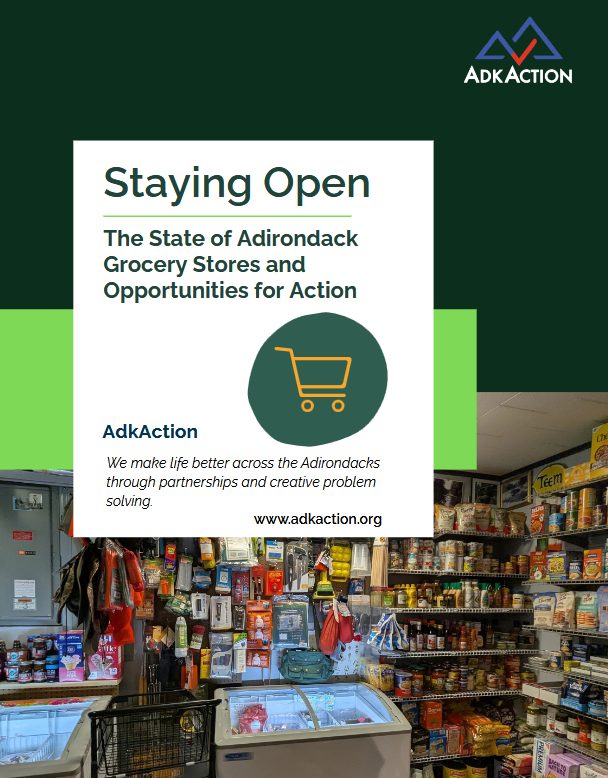
AdkAction’s new rural grocery report Staying Open: The State of Adirondack Grocery Stores and Opportunities for Action, came out of conversations with the people who run them.
The report looks at independent grocery stores across the Adirondack Park and documents the barriers they face, the strengths they bring, and what happens when flexible microgrants are directed where support is needed most.
With funding from the Adirondack Community Foundation’s Generous Acts Fund, rural grocery contractor Lucy Ward worked with eight independent grocers across Clinton, Essex, Hamilton, and St. Lawrence counties.
From 2025 to 2026, AdkAction tested whether small, targeted investments could overcome the grocers’ barriers directly. With funding from Adirondack Community Foundation they awarded micro grants to five independent grocers, letting each grocer identify their own biggest operational barrier.
Small, well-placed support works, they concluded. One grocer’s cardboard compactor replaced six to eight hours of weekly staff time and $400 a month in removal fees.
Prepared foods and higher-margin products carry stores. Delis, bulk goods, local art, and souvenirs build the summer income that sustains stores through the slow winter.
Local stores stay essential, project organizers say. Communities will always need a store close to home to buy essential goods and to run into one another.
The report marks the conclusion of the microgrant pilot project, but it’s just a beginning say organizers.
On October 19, AdkAction gathered regional funders and economic development leaders in a restored church in Au Sable Forks to hear from a panel of grocers from Black Brook General Store, Otto’s Abode in Wanakena, and ADK Trading Post in Long Lake.
“When an emergency hits, our lights are on,” said Nolan Federow of Otto’s Abode. “We see a lot of outdoor recreation and have been the first stop for injuries and people reporting missing hikers. I take a lot of pride in being there for people in those situations.”
Organizers hope the next step is bringing more people to the table to understand and support the rural grocery sector: funders, economic development agencies, government partners, and neighbors who shop at these stores every week.
The approach can serve as a model for other rural regions facing the same questions.

Leave a Reply