
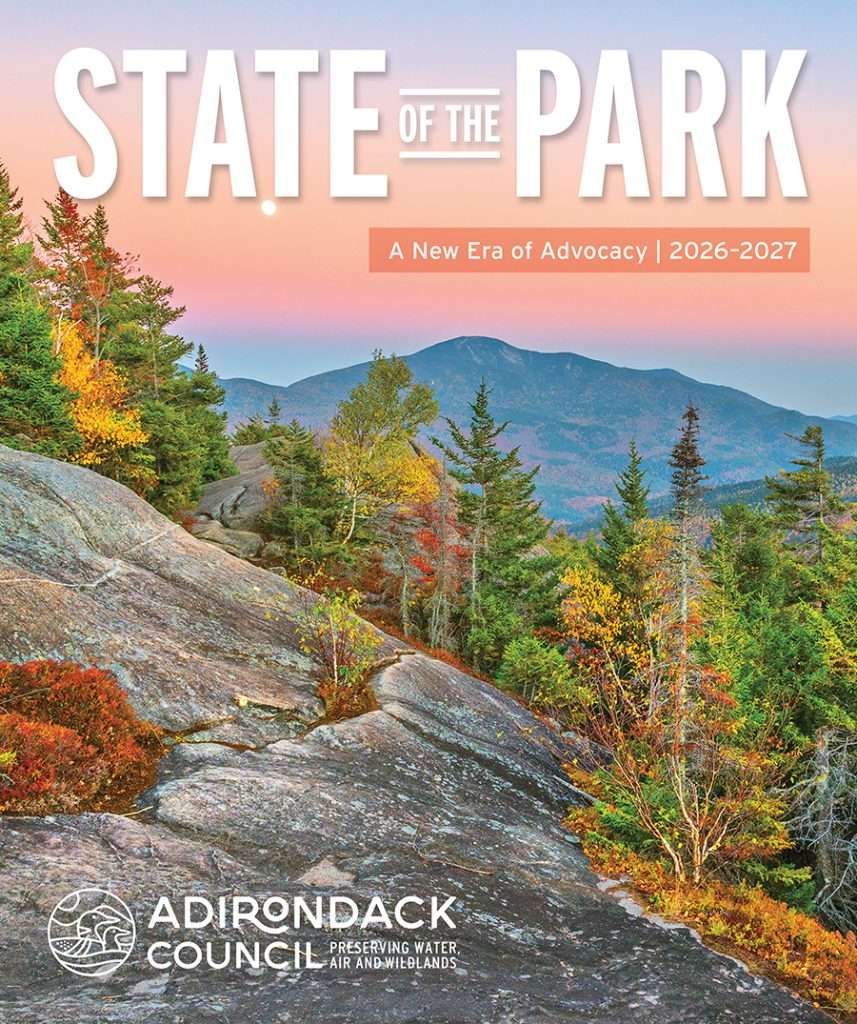
 From federal rollbacks of environmental protections to growing pressure on New York’s landmark environmental laws, the forces shaping the Adirondack Park are changing rapidly. The Adirondack Council’s 45th annual State of the Park report examines the decisions and decision makers that shape the Park’s wild lands, clean waters, and rural communities, indicating the need for renewed advocacy, broader engagement, and stronger conservation leadership.
The 28-page report examines more than 90 significant actions taken by local, state, and federal officials over the past year, highlighting both threats to the Park’s future and opportunities to strengthen its protection.
Spanning 9,300 square miles and six million acres, the Adirondack Park is the largest park in the contiguous United States. Nearly half its area is public land and water, with Forest Preserve lands constitutionally protected as “forever wild.”
The Park is also home to approximately 130,000 year-round residents across 92 towns and nine villages, and welcomes more than 12 million visitors annually.
“Over the past year, we’ve seen federal environmental protections weakened and unprecedented threats to some of our most cherished public lands,” said Adirondack Council Executive Director Raul J. Aguirre.
“Here in New York, we’ve also seen efforts to weaken the nation-leading Climate Leadership and Community Protection Act and the State Environmental Quality Review Act. These changes at both the national and state level make our work more important than ever.
“It’s also clear that strong bipartisan, grassroots support for public lands protection and access remains strong, and that is a source of optimism and hope.”
Aguirre said that broad support will be critical as the Adirondack region confronts major decisions about its future, including the protection of the Whitney Estate, one of the Park’s most important remaining links to connect a network of valuable wildlife habitats and protected open space.
“The changes we are seeing bring uncertainty but can also create an opportunity to build new partnerships and bring more people into the work of protecting the Adirondacks,” Aguirre said.
“With leadership transitions in Albany, Washington, and communities across the Park, we have an opportunity to strengthen that shared commitment. The challenge is to turn broad public support for the Adirondacks into lasting action.”
The report comes at a time of significant political transition. Twelve members of the New York Legislature retired this year, including key committee chairs, while seven of Essex County’s 18 supervisors also stepped down.
With statewide offices and New York’s 21st Congressional District on the ballot in November, new leaders will help shape decisions affecting the Park’s lands, waters, climate, and communities.
Highlights from the 2026 State of the Park Report
The report examines more than 90 actions by government officials, courts, local governments, and nonprofit organizations that shaped the Adirondack Park over the past year. Highlights include:
State Leadership: Progress and Setbacks
Governor Kathy Hochul received praise for environmental funding, resisting efforts to motorize wilderness areas, pausing state approvals for data centers, and committing funds toward protecting the 36,000-acre Whitney Estate in Long Lake. The report also criticizes changes to New York’s climate law and State Environmental Quality Review Act enacted through closed-door budget negotiations.
The State Legislature earned credit for expanding environmental funding and improving wildlife management, but drew criticism for failing to address road salt use on state highways or advance plans for reusing three former prison facilities in and around the Park.
Environmental Agencies: Conservation Gains and Unfinished Work
The New York State Department of Environmental Conservation (DEC) received praise for efforts to protect fragile mountain ecosystems, improve lake-water quality, continued efforts to restore spruce grouse populations, conserve private lands, and support smart growth practices.
The report also highlights overdue plans and rules for open-space conservation, wildlife protection, and Forest Preserve trail construction, along with the agency’s decision not to appeal a court ruling striking down its revised wetlands regulations.
The Adirondack Park Agency (APA) was recognized for convening its first adjudicatory hearing in 15 years to review a proposal to test-fire a military howitzer in Essex County.
It also received credit for improving public access to land-use information and advancing appropriately sited solar development. The report urges the agency to better protect remoteness, address cumulative development impacts, and establish a consistent policy for reviewing solar projects.
Courts and the Attorney General: Defending Environmental Protections
Federal and state courts challenged efforts to weaken air-quality protections, upheld New York’s All-Electric Buildings Act, and required progress on the state’s overdue carbon allowance-trading program.
Attorney General Letitia James received praise for challenging federal rollbacks affecting air quality, greenhouse-gas regulation, and commercial refrigerants, and for defending the APA’s authority to review complex land-use proposals.
Federal Policy: Growing Pressures on the Park
The report recognizes the U.S. Geological Survey’s decades of research documenting the recovery of Adirondack trout waters from acid rain and congressional efforts to secure funding for regional health care, education, infrastructure, and tourism.
It also criticizes federal rollbacks of protections for air quality, roadless lands, endangered species, and wetlands. Changes to national park visitor-management programs, the closure of three U.S. Forest Service offices in New York, and the broader U.S.-Canada dispute disrupting cross-border travel raised additional concerns for the region’s environment and economy.
Local Leadership and Conservation Partnerships
Local governments and organizations demonstrated practical approaches to conservation and community well-being. Examples include Warren County’s efforts to reduce road salt use, Queensbury’s municipal solar project on a closed landfill, Franklin County support for local food producers, the Town of Jay’s opposition to military cannon test-firing, and conservation education efforts in Hamilton County.
Spotlight on Conservation Leadership
The report also recognizes organizations and individuals contributing to the Park’s environment, culture, and communities, including the Lake George Association, AdkAction, the Akwesasne Land Resource Program, Adirondack North Country Association, Adirondack Architectural Heritage, the Adirondack Experience, the Wild Center, and other regional partners.
You can read the State of the Park report here.

Leave a Reply