
 Evert or Eeuwout was born in in Amerongen in 1659, the son of Gerrit Theunisz de Ridder and Marrigje Ewouts Rietveld, he was baptized on Saturday the first of May in 1659 in the church of Saint Andries. Members of the de Ridder family still live in Amerogen on the Rhine in the Dutch province of Utrecht, but Evert de Ridder brought a branch of the family to New York in the 1680s.
Evert’s father Gerrit was born in Ameide on the Lek river, as the Rhine is called further downstream. He was a wheelwright in nearby Nieuwpoort, also on the river Lek. He acquired citizenship there and the first four of his eleven children were born there. In 1653 the family moved to the east, to Amerongen where they became members of the Dutch Reformed Church. Gerrit was an active member as an elder.
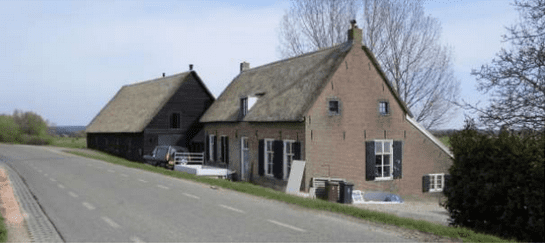
In Amerongen Gerrit became keeper of the inn called The 40 Gardens, laying on the dike that connects the towns of Wijk bij Duurstede and Amerongen. It’s likely that Evert was born in the this house which has survived for more than 450 years, one of the very few buildings to survive the French invasion of 1672. In 1657 Gerrit sought and was granted permission to build a barn next to house on the land of his lordship Montaigne from the bailiff responsible for the quality of the dike. Gerrit became a member of the dike board and an alderman for some years.
 A few years later destiny calls for the de Ridder family, as the French military moves into Amerongen. The local castle was set a light by the French, after the lord of the manor refused to pay a ransom. The vicar reported on the sad exodus of the residents just before the French invasion June 9th 1672:
“On Tuesday morning my family and the whole congregation had to flee from our town as a herd of sheep with just a package under the arm and some with children by the hand, followed briefly on the heels by the French. Some fled to the nearby cities other to the Hague and Amsterdam. Me and [the] former inn [keeper of] ‘the 40 Gardens,’ on the river dike, Amerongen… my house family have been staying within the city of Utrecht for some time. Like the province, the city was taken immediately. The situation is such that no church meetings were held in nearby Rhenen, which is just as well, because no magistrate or reverend were left behind.”
In 1673, after the departure of the French, the minutes of the consistory reported that Gerrit de Ridder perished from exhaustion caused by the French. Evert de Ridder’s mother also died in the war. “They leave six children, that have been completely plundered, they now have to earn their living with their bare hands,” it was reported.
Bankruptcy soon followed and an attempt was made to collect the amounts due creditors for the maintenance work on the polders of the river, and in 1677 the The 40 Gardens was sold.
When his parents died, Evert de Ridder was just 13 years old. It’s likely that he has been taken care of by his brother Jan, who was 10 years older. From an early age Jan held the same positions as his father. An entry in the membership book of the church says that he has left for Amsterdam, probably indicating he has left for the colonies.
Why would a young man from Amerongen emigrate to America? The disaster of 1672 had been a traumatic experience. Evert has lost both his parents at a vulnerable age and had to live through the process of bankruptcy and the loss of his parental home. The village has been devastated to a large degree and it would take quite some time to recover.
It is likely that Evert heard from his parents that many people had left for New Netherland after the end of the 80-year war of independence of the Netherlands from Spain. Many emigrated to the New World from the region where the de Ridders lived.
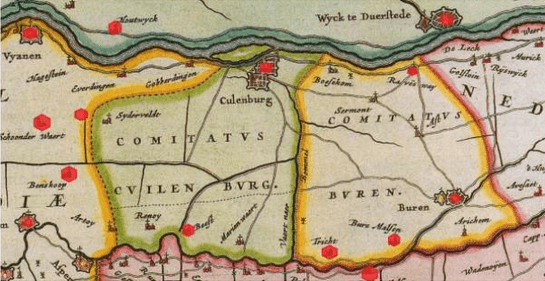 Martin van Buren, the eighth President of the United Stated, came from this same area. The Van Cortlandt family originates from Wijk bij Duurstede at the end of the dike, where Evert grew up. They were an influential political dynasty from the 17th and into the 19th century. And then there is the van Ness family from the same region where Gerrit comes from. More about them later.
The Atlantic crossing could take between 50 and 120 days, sometimes longer. Passengers slept below deck in narrow bunks with little fresh air or little light; sanitary conditions were poor and the available food primitive. After disembarking in New York it might take a day or several for emigrants to make their way up the Hudson River by sloop.
Shortly after arrival, a recommendation letter from the church of Amerongen allowed him to join the congregation of the Dutch Reformed Church of Albany, part of the Amsterdam consistory.
Anna van Ness is member of the same church. Her father was born near the town of Vianen, as was Everts’ father. In 1688 Anna and Evert married in the Dutch Reformed Church of Albany. Evert began earning a living by teaching the children of Albany, and later served as a tax collector. He and Anna had 11 children, as his parents had.
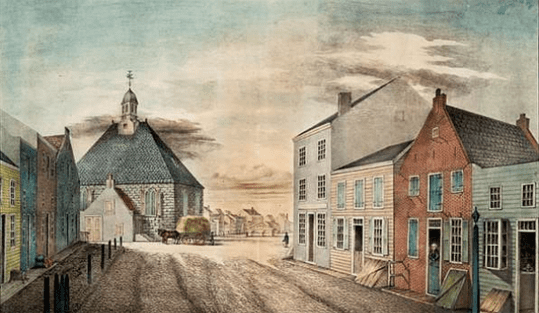 Despite a distance of thousands of miles the surroundings in Albany must have been reasonably familiar for Evert, in part because of the large numbers of Dutch speakers. In 1703 he became a free citizen of the town and was officially appointed educator of the school.
Evert was a concerned citizen, like his father was. He took up arms in the Leisler rebellion against the English in 1690, as a lieutenant in the militia of Jacob Leisler, who leads the rebellion. The rebellion took place during the rule of (Dutch) King William III of England.
In the same year he served as a lieutenant of a band of volunteers that are sent to Schenectady to bring the perpetrators of the Schenectady Massacre to justice.
Everts’ granddaughter, Antje de Ridder, married Abraham Yates, Jr., who served as an inaugural U.S. Senator from New York and later Mayor of Albany after the American Revolution.
Leo Schreuders MBA CPA is a retired economist who writes about Amerongen in the 17th century.
Illustrations, from above: the church of St. Andries Amerongen, at the edge of the polder; Former Inn “the 40 Gardens,” on the river dike, Amerongen; the region of origin of many emigrants to New Netherland (red marks towns emigrants came form); and the first Dutch Church on the crossing of Jonker and Market Street, Albany, 1805 (by James Eights).
The house built ca. 1720 by Evert’s son, Hendrick de Ridder, still stands in the Town of Colonie.
Thank you Paul for your comment.
I know you are well versed in New Netherlands history. I tried to get a picture out of google, can you help me with that?
Can I also refer you to:
Living with Rivers
de Halve Maen [Dutch Colonial Period], 2017
To a large extent, the Dutch settlers in New Netherland were farmers. They made the early modern American mid-Atlantic region a success, duplicating the Dutch agricultural powerhouse overseas. This article highlights the Netherlands Plain as the principal place of origin for immigrants to New Netherland by mapping out the émigré villages. Another focus is to unveil motives for emigration, some of a circumstantial nature, a few based on more personal observations.
I can easily send you a photo of the DeRidder house if you provide an e-mail address. The walls are filled with soft, yellow, small klincker-sized, sun-dried clay brick, and the clay contains many small seeds or grains. If a brick fragment is left out in the rain, it washes away. I have never seen such construction anywhere else.
I subscribe to de Halve Maen.
leonardhschreuders@gmail.com
thx